Serge Parapine
Journey to the End of the NightSerge Parapine is an established typhoid specialist and former instructor to Ferdinand Bardamu, but his scientific standing does not translate into certainty or effective guidance. When Bardamu seeks his help for Bébert, Parapine is willing to assist, yet years of research have left him unable to settle on a clear treatment. His character joins genuine kindness to professional exhaustion: he knows a great deal, sees through the performance of scientific authority, and has little faith that knowledge can deliver the answer a sick child needs.
Identity and Background
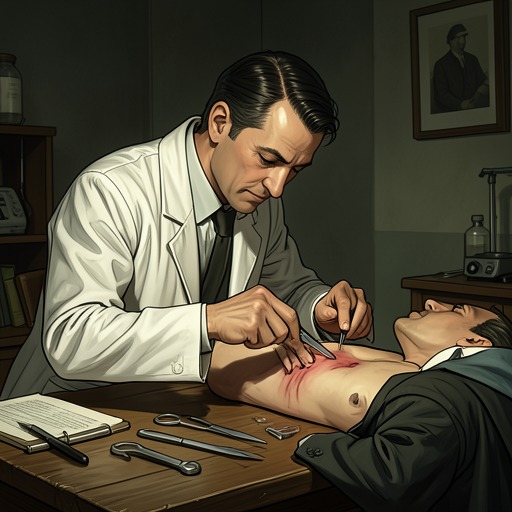
Parapine’s reputation in typhoid research reaches back about twenty years. His public breakthrough came in a contest with German researchers, who had reported isolating the Eberthella bacterium from the vaginal excreta of an eighteen-month-old girl. Taking up the challenge on behalf of the National Institute, he cultivated the same microbes in pure form from the sperm of a seventy-two-year-old invalid. The startling claim made him famous, and he maintained that visibility by publishing columns in medical journals that the narrator describes as unreadable.
His standing rests partly on the trust of the scientific public. That public, the narrator observes, accepts Parapine’s authority without reading his work; scrutiny, in this sardonic account, might slow the progress everyone claims to desire. The episode presents prestige not as proof that research has resolved its questions, but as a social arrangement capable of sustaining a celebrated specialist whose publications few people consult.
Meeting with Bardamu
Bardamu travels from Rancy to the Joseph Bioduret Institute because Bébert’s typhoid has resisted treatment. After wandering through the Institute in search of him, Bardamu finds Parapine at work in his laboratory. The narrator recalls that Parapine had taught him to use a microscope during medical school and had shown him kindness, giving Bardamu reason to hope that the old connection might still matter. Bardamu is intensely preoccupied with the child’s case and wants advice that could improve his treatment.
Parapine welcomes the request and asks about the therapies Bardamu has tried, including serums and vaccines. But instead of offering a decisive clinical direction, he raises questions about whether these treatments work and notes that some respected minds reject vaccines. He weighs competing positions aloud, turning the consultation into a display of uncertainty rather than a confident prescription. His learning is real; the difficulty is that it gives him no firm basis for choosing among the alternatives.
Scientific Reputation and Institutional Satire
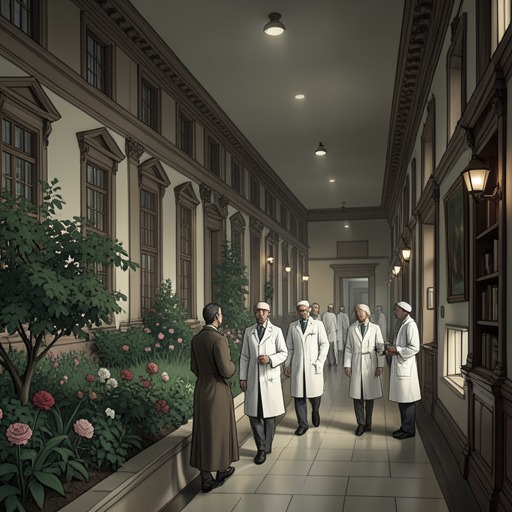
Parapine’s encounter with Bardamu takes place in a research institution that the narration depicts as more dispiriting than triumphant. Bardamu first passes through laboratories strewn with equipment and signs of neglect, then waits for staff to appear. The contrast between the Institute’s authority and its shabby working environment prepares for Parapine’s own account of scientific ambition: the institution is a place where reputation and professional survival coexist with disorder, rivalry, and doubt.
Parapine is especially scornful of the technician who has worked for him for nearly thirty years. The technician, unlike the researchers around him, has come to believe in the significance of the cultures he handles and is devoted to them. Parapine compares this faith to religious belief that persists among a priest’s attendants after the priest has lost his own. The comparison captures his divided position: he remains inside scientific work, but regards much of its certainty as a kind of ritual sustained by those who do not see its absurdity.
His contempt extends to Joseph Bioduret, the Institute’s celebrated namesake. Parapine describes the famous scientist as petty, quarrelsome, and megalomaniacal, arguing that the habits and manias behind Bioduret’s reputation offer little to admire. In this portrait, scientific eminence does not guarantee admirable character or profound insight. Parapine’s fierce denunciation is itself part of the scene’s satire: he can puncture the reverence surrounding research, but his own manner is marked by grievance and a need to keep speaking.
Exhaustion and Character
Parapine confesses that typhoid research has become intolerably crowded. When he began, he says, there were few specialists and researchers could advance one another’s reputations; now competitors arrive from around the world, publishing on the same familiar subject. To preserve his position, he repeatedly rewrites the same article, making small changes for one congress or journal after another. His professional life has narrowed into the maintenance of a niche rather than the pursuit of a discovery.
He even imagines retreating into a safer subject: a study of how central heating affects hemorrhoids in northern and southern countries, with hygiene and diet as further variables. He expects a carefully prolonged project of this kind might please the Academy while attracting neither enemies nor disciples. The joke exposes the calculation beneath his fatigue. He is not only disenchanted with scientific competition; he is searching for a modest, protected place within it, where recognition can continue without the risks of serious rivalry.
Relationship to Bardamu and Narrative Significance
Parapine’s history with Bardamu is brief but consequential. He once taught the younger doctor practical microscopy and treated him kindly; later, when Bardamu arrives with Bébert’s case, he responds generously. Yet he cannot convert their personal trust into a usable answer. After talking at length about the Institute, its people, and his own disillusionment, Parapine returns to the patient’s problem and advises Bardamu to do his best, since reason cannot select among so many unstable theories and questionable experiments.
That advice clarifies both his limitation and his humanity. Parapine does not refuse to help, but the accumulated knowledge that made him an authority has left him unable to promise that any particular treatment will save Bébert. His scene contrasts the institutional language of expertise with the urgent, particular need of a child and the doctor trying to care for him. Parapine’s career thus embodies a central tension in the episode: scientific systems can confer status and generate endless debate, while in the sickroom the practitioner must still act under uncertainty and accept that effort may not control the outcome.